





In today’s fast-paced digital economy, businesses are under constant pressure to deliver software faster, cheaper, and with higher quality. Stakeholders expect rapid prototypes, quick iterations, and measurable ROI – often all at once. This demand has fueled the rise of low-code and no-code platforms, promising accelerated development with minimal coding.
However, as organizations mature digitally, they quickly realize a key truth: not everything can or should be built using low-code alone. Complex business logic, scalability requirements, security constraints, and deep integrations often demand traditional engineering expertise.This is where the Low-Code Hybrid approach becomes essential. At VBridge, we help organizations strike the right balance – using low-code where it delivers speed and efficiency, and custom engineering where precision, flexibility, and long-term scalability matter most.
Understanding Low-Code: Speed as a Strategic Advantage
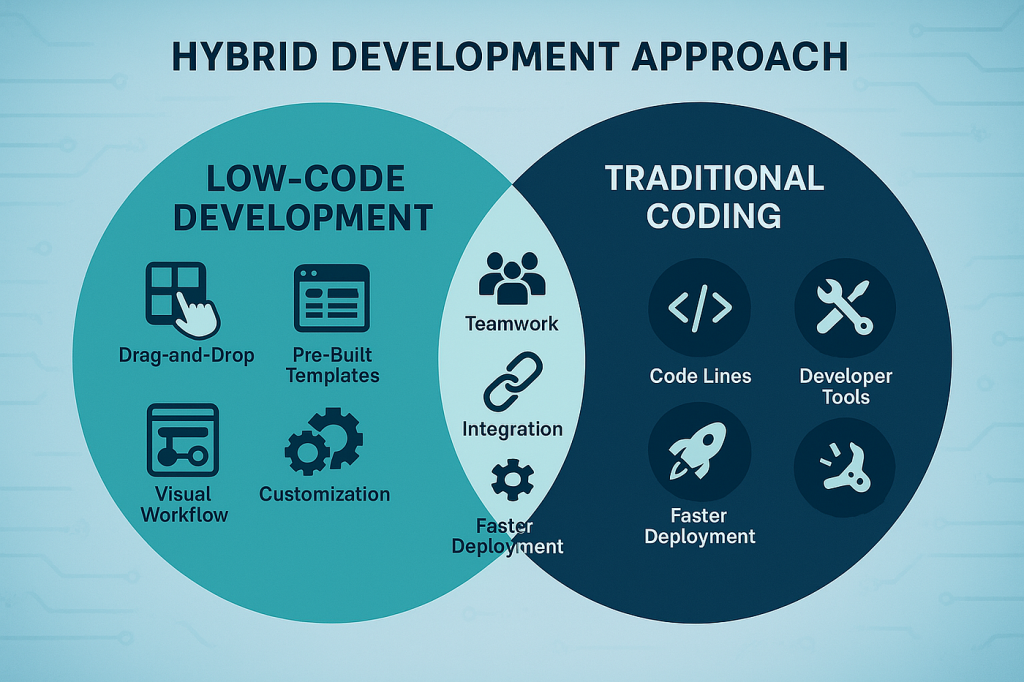
Low-code platforms provide visual development environments with drag-and-drop components, prebuilt connectors, and declarative logic. They significantly reduce development time and lower the entry barrier for building applications.
Low-code is a strong fit when:
· Time-to-market is critical: MVPs, proof-of-concepts, and pilot projects can be launched in weeks instead of months.
· Requirements are well-defined and stable: Simple workflows, forms, dashboards, and CRUD-based applications.
· Business-user involvement is high: Citizen developers or power users can actively participate in development.
· Standard integrations are sufficient: CRM, ERP, ticketing tools, and common SaaS platforms.
Typical Use Cases
· Internal process automation
· Approval workflows
· Admin panels and reporting dashboards
· Rapid prototyping for product validation
Low-code enables organizations to move fast and validate ideas early, reducing upfront investment and risk.
The Limitations of Pure Low-Code Approaches
While low-code accelerates development, relying on it exclusively can introduce challenges as systems scale and evolve.
Common Constraints
· Limited customization: Complex algorithms, domain-specific rules, or advanced UX requirements can be difficult or impossible to implement.
· Vendor lock-in: Applications are often tightly coupled to the platform’s ecosystem.
· Performance and scalability ceilings: High-volume transactions and real-time systems may struggle.
· Security and compliance gaps: Advanced security models, custom authentication, and regulatory compliance can be constrained.
· Maintainability issues: Visual logic can become hard to manage in large, long-lived applications.
At this stage, organizations often face a critical decision: refactor, rebuild, or extend beyond the low-code platform.
Custom Engineering: Where VBridge Adds Maximum Value
Custom engineering provides full control over architecture, performance, and evolution. At VBridge, our engineering teams specialize in building robust, scalable, and future-proof systems tailored to complex business needs.
When Custom Engineering Is the Right Choice
Choose custom development when:
· Business logic is complex or unique
· High scalability and performance are non-negotiable
· Deep system integrations are required (legacy systems, proprietary APIs, data pipelines)
· Security, compliance, and governance are critical
· Long-term product evolution is expected
VBridge Engineering Strengths
· Backend systems using modern frameworks (Laravel, Spring Boot, Node.js)
· Scalable cloud-native architectures
· API-first and microservices-based design
· Secure data handling and compliance-driven development
· Clean, maintainable, and testable codebases
Custom engineering ensures that your software is built to last, not just built to launch.
The Low-Code Hybrid Model: Best of Both Worlds
The Low-Code Hybrid approach combines the speed of low-code with the power of custom engineering. Instead of choosing one over the other, organizations can strategically use both.
How the Hybrid Model Works
· Low-code for the front layers: Rapid UI development, internal tools, simple workflows
· Custom engineering for the core: Business logic, integrations, data processing, and scalability
· APIs as the bridge: Clean separation between low-code apps and custom-built services
This approach enables:
· Faster delivery without sacrificing flexibility
· Reduced development costs in early stages
· Smooth transition from MVP to enterprise-grade systems
VBridge’s Approach to Low-Code Hybrid Delivery
At VBridge, we don’t promote low-code as a silver bullet – nor do we dismiss it. Instead, we architect solutions based on business outcomes.
Our Decision Framework
We help clients answer key questions:
· What needs to be delivered quickly?
· What must scale long-term?
· Which parts of the system are likely to change?
· Where does differentiation truly matter?
Based on these answers, we design a hybrid architecture that evolves with the business.
Real-World Scenarios
· Startups: Launch MVPs using low-code, then progressively replace critical components with custom services.
· Enterprises: Use low-code for departmental tools while core platforms are engineered by vBridge.
· Digital Transformation: Modernize legacy systems incrementally without disrupting operations.
Key Benefits of the Low-Code Hybrid Strategy
· Speed without shortcuts: Faster delivery without compromising architecture
· Cost optimization: Invest engineering effort where it matters most
· Reduced risk: Validate ideas early, scale confidently later
· Future-ready systems: Avoid painful rewrites and platform limitations
Conclusion: Choose Balance, Not Extremes
The future of software development is not low-code versus custom engineering – it is low-code with custom engineering.
By adopting a Low-Code Hybrid approach, organizations can innovate faster while building systems that are secure, scalable, and sustainable. With VBridge as your engineering partner, you gain the strategic insight to decide what to build fast and what to build right.
Speed launches products. Engineering sustains them. VBridge delivers both.