





Digital marketing in 2026 is no longer about juggling multiple tools manually—it’s about automation, real-time data, and seamless integrations. Agencies that rely on disconnected platforms risk inefficiencies, higher costs, and missed opportunities.
The solution? Strategic API integrations.
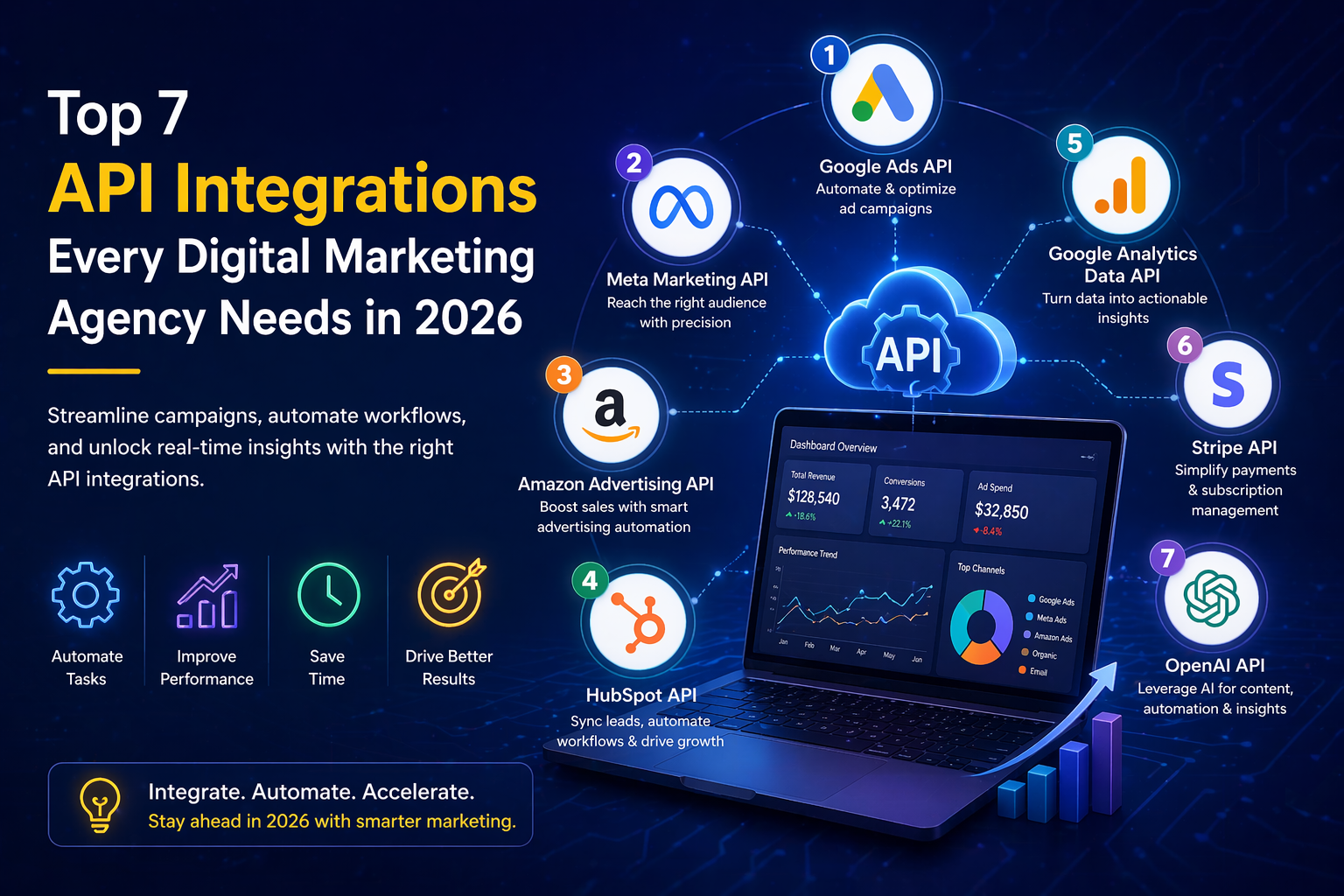
In this article, we’ll explore the 7 most essential API integrations every digital marketing agency should adopt to stay competitive, reduce manual work, and scale effectively.
1. Google Ads API
The Google Ads API remains the backbone of paid advertising automation.
Why it matters:
- Automate campaign creation and updates
- Real-time bid adjustments
- Bulk keyword and ad management
- Advanced reporting beyond UI limitations
Use case:
Automatically pause underperforming ads and reallocate budget to high-performing campaigns—without human intervention.
2. Meta Marketing API
With billions of users across Facebook and Instagram, integrating the Meta Marketing API is essential.
Key benefits:
- Automated ad creation across platforms
- Audience targeting using custom datasets
- Real-time performance tracking
- Dynamic creative optimization
Use case:
Sync CRM data to create high-converting lookalike audiences instantly.
3. Amazon Advertising API
For agencies managing eCommerce clients, Amazon Ads is a goldmine.
Why you need it:
- Automate sponsored product campaigns
- Optimize bids using performance data
- Track conversions at granular levels
- Manage multiple seller accounts efficiently
Use case:
Automatically increase bids on products with high conversion rates during peak hours.
4. HubSpot API
Marketing without CRM integration is incomplete.
What it enables:
- Sync leads and customer journeys
- Trigger campaigns based on user behavior
- Align sales and marketing data
- Automate email workflows
Use case:
Trigger personalized email campaigns when a lead interacts with ads or landing pages.
5. Google Analytics Data API
Data-driven decisions depend on accurate analytics.
Benefits:
- Pull real-time website and campaign data
- Build custom dashboards
- Combine data from multiple sources
- Automate reporting
Use case:
Generate automated weekly performance reports for clients without manual effort.
6. Stripe API
For agencies offering SaaS or subscription services, Stripe integration is critical.
Why it matters:
- Automate billing and invoicing
- Track revenue metrics
- Manage subscriptions
- Integrate payment data with marketing
Use case:
Trigger retention campaigns when a subscription is about to expire or fails.
7. OpenAI API
AI is no longer optional—it’s a competitive advantage.
What it enables:
- Automated ad copy generation
- Chatbots for lead qualification
- Content personalization
- Predictive analytics
Use case:
Generate high-performing ad variations dynamically based on audience segments.
🚀 Why API Integration Is Critical in 2026
Modern agencies are moving toward fully automated marketing ecosystems. API integrations help you:
- Reduce manual workload by up to 60%
- Improve campaign performance with real-time optimization
- Scale operations without increasing team size
- Deliver faster and more accurate reporting to clients
💡 The Competitive Advantage
Agencies that invest in API-driven automation gain:
- Faster campaign execution
- Better ROI for clients
- Stronger data insights
- Higher client retention
On the other hand, agencies relying on manual processes will struggle to compete.
🧠 Final Thoughts
The future of digital marketing lies in connected systems, automation, and AI-driven decisions. By integrating the right APIs, agencies can transform from service providers into scalable, technology-driven growth partners.
If you’re looking to implement these integrations or build a custom automation system, this is where a technical partner like vBridge Technologies can make a real difference—combining API expertise, cloud infrastructure, and scalable architecture to deliver measurable results.