



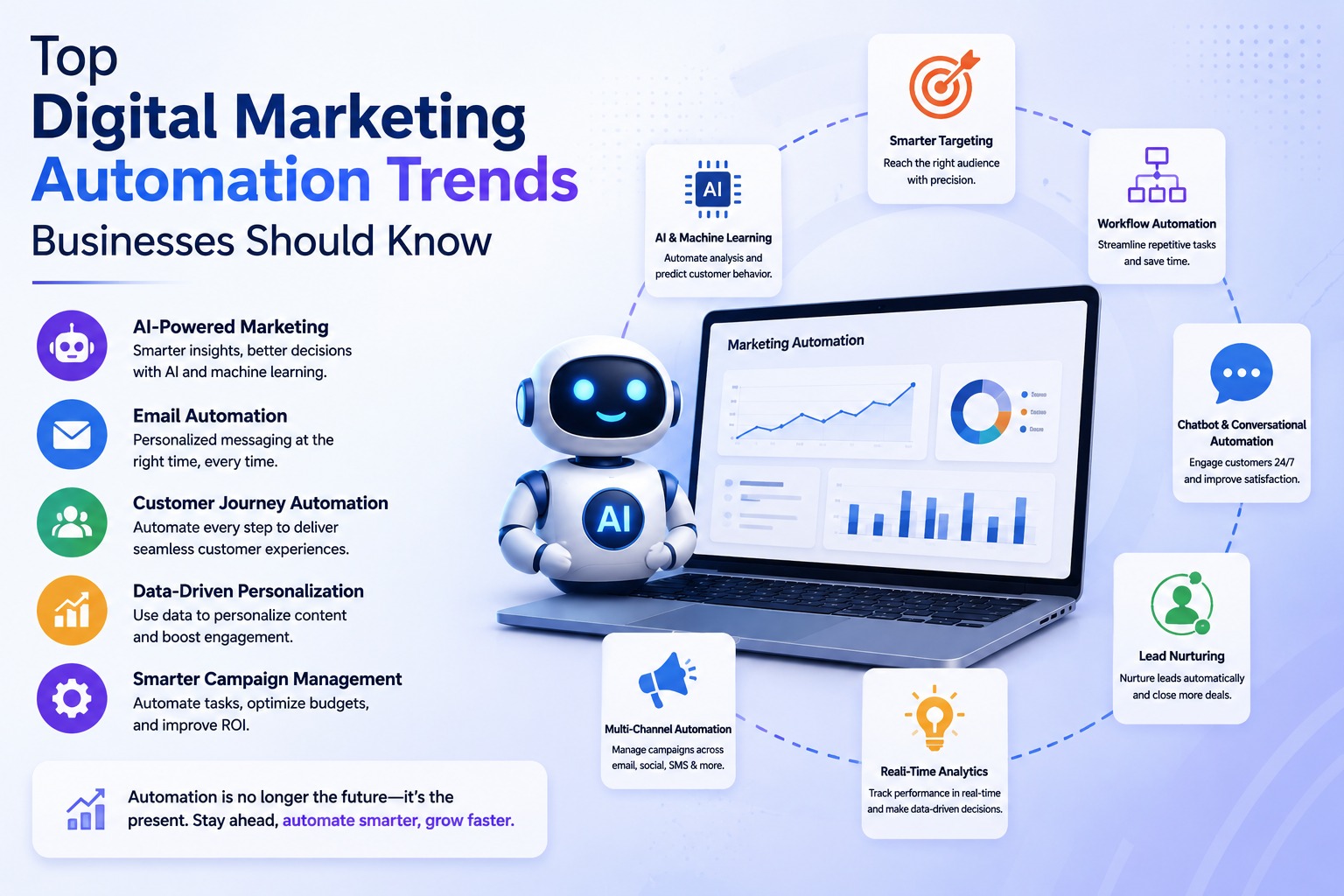
Digital marketing automation is helping businesses improve customer engagement, automate repetitive tasks, and increase sales more efficiently. With technologies like Artificial Intelligence (AI), machine learning, and data analytics, companies can automate emails, optimize ads, manage social media, and personalize customer experiences in real time.
As customer expectations continue to grow, businesses are using automation to provide faster responses and better communication across multiple platforms. In this blog, we explore the top digital marketing automation trends businesses should know in 2026.
1. AI-Powered Marketing Automation
Artificial Intelligence is becoming one of the most important technologies in digital marketing automation. Businesses are now using AI-powered tools to automate complex marketing tasks that previously required human effort. AI can analyze massive amounts of customer data, identify buying patterns, predict future behavior, and optimize campaigns automatically.
AI-driven marketing platforms help businesses improve customer targeting by analyzing user interests, browsing history, demographics, and online activity. These insights allow marketers to deliver highly relevant content and advertisements to the right audience at the right time. AI also improves campaign performance by automatically adjusting ad placements, bidding strategies, and audience targeting in real time.
Another major advantage of AI automation is content generation. AI tools can create email subject lines, social media captions, blog outlines, ad copy, and product descriptions quickly. While human creativity remains important, AI helps businesses save time and increase productivity. As AI technology continues to evolve, businesses will increasingly rely on automation to improve marketing efficiency and customer engagement.
2. Hyper-Personalization
Personalization has become a key factor in successful digital marketing. Modern customers expect brands to understand their preferences and deliver customized experiences. Generic marketing messages are no longer effective because customers want relevant content that matches their interests and needs.
Hyper-personalization uses customer data, AI, and automation tools to deliver highly targeted content and recommendations in real time. Businesses can personalize emails, website experiences, product suggestions, advertisements, and promotional offers based on customer behavior and purchase history.
For example, eCommerce businesses can recommend products based on previous purchases or browsing activity. Streaming platforms suggest content based on viewing preferences, while email campaigns can deliver personalized messages based on customer engagement patterns. This level of personalization improves customer satisfaction, increases engagement, and boosts conversion rates.
Automation tools make hyper-personalization scalable, allowing businesses to deliver unique experiences to thousands of customers simultaneously. Companies that invest in personalized marketing strategies are more likely to build stronger customer relationships and improve brand loyalty.
3. Automated Email Marketing
Email marketing remains one of the most effective digital marketing channels, and automation has made it even more powerful. Automated email marketing allows businesses to send targeted messages to customers based on their actions, interests, and interactions with the brand.
Businesses can automate welcome emails for new subscribers, abandoned cart reminders for online shoppers, follow-up emails after purchases, promotional campaigns, customer retention emails, and re-engagement campaigns for inactive users. These automated workflows help businesses maintain consistent communication with customers without manual intervention.
Email automation also improves customer segmentation. Businesses can divide audiences into different groups based on demographics, purchase behavior, interests, or engagement levels. This helps marketers send highly relevant content that improves open rates, click-through rates, and conversions.
Advanced email automation platforms also provide detailed analytics, allowing businesses to track campaign performance, customer engagement, and conversion metrics. By continuously optimizing email campaigns, businesses can improve ROI and strengthen customer relationships.
4. Chatbots and Conversational AI
AI-powered chatbots are transforming customer communication and support. Customers today expect instant responses when interacting with businesses online. Chatbots help companies provide 24/7 support while reducing the workload on customer service teams.
Modern chatbots use Natural Language Processing (NLP) and AI to understand customer questions and provide accurate responses in real time. Businesses are integrating chatbots into websites, mobile apps, WhatsApp, Facebook Messenger, and other communication platforms to improve customer interactions.
Chatbots can answer frequently asked questions, assist with product recommendations, collect customer information, qualify leads, schedule appointments, and even process orders. This improves customer satisfaction by providing fast and convenient support experiences.
Conversational AI is also becoming more advanced with voice-enabled interactions and multilingual support. Businesses that adopt chatbot automation can improve customer engagement, increase lead generation, and reduce operational costs significantly.
5. Omnichannel Marketing Automation
Customers interact with brands through multiple channels, including websites, mobile apps, social media, email, SMS, and messaging platforms. Businesses must provide a consistent and seamless experience across all these touchpoints to maintain customer engagement.
Omnichannel marketing automation helps businesses manage communication across different platforms from a single system. This ensures that customers receive a unified experience regardless of where they interact with the brand.
For example, a customer may discover a product on Instagram, receive a promotional email later, visit the website to learn more, and finally make a purchase through a mobile app. Omnichannel automation ensures that all these interactions are connected and personalized.
Businesses can automate customer journeys, track engagement across channels, and deliver targeted content based on user activity. This improves customer experiences, increases brand consistency, and enhances marketing effectiveness.
6. Predictive Analytics
Predictive analytics is becoming a powerful trend in marketing automation. By using AI and historical customer data, businesses can predict future customer behavior and make smarter marketing decisions.
Predictive analytics helps businesses identify which customers are most likely to make purchases, which leads are most valuable, and which marketing campaigns are likely to perform best. Companies can also forecast sales trends, customer churn, and product demand more accurately.
These insights allow businesses to optimize marketing strategies, improve customer targeting, and allocate budgets more effectively. Predictive analytics also helps businesses create proactive marketing campaigns instead of reacting to customer behavior after it happens.
As data-driven marketing continues to grow, predictive analytics will become an essential tool for businesses looking to improve performance and gain competitive advantages.
7. Automated PPC Campaign Optimization
Pay-Per-Click (PPC) advertising is an important part of digital marketing, but managing campaigns manually can be time-consuming and complex. Businesses are increasingly using automation tools to optimize PPC campaigns and improve advertising performance.
Automation platforms can automatically adjust bids, pause underperforming ads, allocate budgets, optimize keywords, and improve audience targeting based on campaign data. This helps businesses maximize ad performance while reducing wasted advertising spend.
AI-powered PPC automation also improves ad personalization and targeting accuracy. Businesses can create dynamic ads that adapt to user behavior and preferences in real time. Automation tools continuously monitor campaign performance and make adjustments instantly to improve ROI.
By automating PPC management, businesses can focus more on strategy and creativity while allowing AI systems to handle repetitive optimization tasks.
8. Voice Search Optimization
Voice search is becoming increasingly popular due to the rise of voice assistants like Alexa, Siri, and Google Assistant. More users are now searching for information using conversational voice queries instead of traditional text searches.
Businesses must optimize their content for voice search to remain visible in search engine results. Voice searches are often longer and more conversational, requiring businesses to focus on natural language keywords and question-based content.
Marketing automation tools can help identify trending conversational keywords and optimize content strategies for voice search. Businesses are also improving local SEO and mobile optimization to support voice-based searches.
As voice technology continues to grow, companies that optimize for voice search early will gain better visibility and reach wider audiences.
9. AI-Generated Content
Content marketing remains a critical part of digital marketing strategies, and AI-generated content is becoming increasingly common. AI tools can quickly generate blog drafts, social media posts, product descriptions, email campaigns, and advertising copy.
Businesses use AI-generated content to improve efficiency, reduce content production time, and maintain consistent publishing schedules. AI can analyze audience interests and trending topics to create relevant content ideas that align with customer preferences.
Although AI-generated content saves time, human creativity and editing remain important to ensure authenticity, originality, and emotional connection with audiences. The best strategy is often combining AI efficiency with human expertise.
As AI writing tools become more advanced, businesses will continue using them to scale content marketing efforts more effectively.
10. Privacy-First Marketing
Privacy regulations and changing customer expectations are reshaping digital marketing strategies. With the decline of third-party cookies and increasing concerns about data privacy, businesses must adopt privacy-first marketing practices.
Customers want greater transparency regarding how their data is collected and used. Businesses are now focusing more on first-party data collection through websites, subscriptions, customer accounts, and direct interactions.
Consent-based marketing is becoming increasingly important. Companies must clearly communicate privacy policies, obtain user consent, and ensure secure handling of customer data. Businesses that prioritize privacy and transparency can build stronger customer trust and improve brand reputation.
Marketing automation tools are also evolving to support privacy-compliant data collection and customer communication strategies. Companies that adapt to privacy-first marketing will be better prepared for future digital marketing regulations.
Conclusion
Digital marketing automation has become essential for businesses that want to grow and stay competitive. Technologies like AI, predictive analytics, chatbots, and omnichannel marketing are helping companies improve customer engagement, increase efficiency, and optimize campaigns in real time.
Businesses that adopt modern automation tools can generate better leads, improve conversions, and achieve higher ROI. As digital marketing continues to evolve in 2026, companies that embrace automation early will be better positioned for long-term success.