





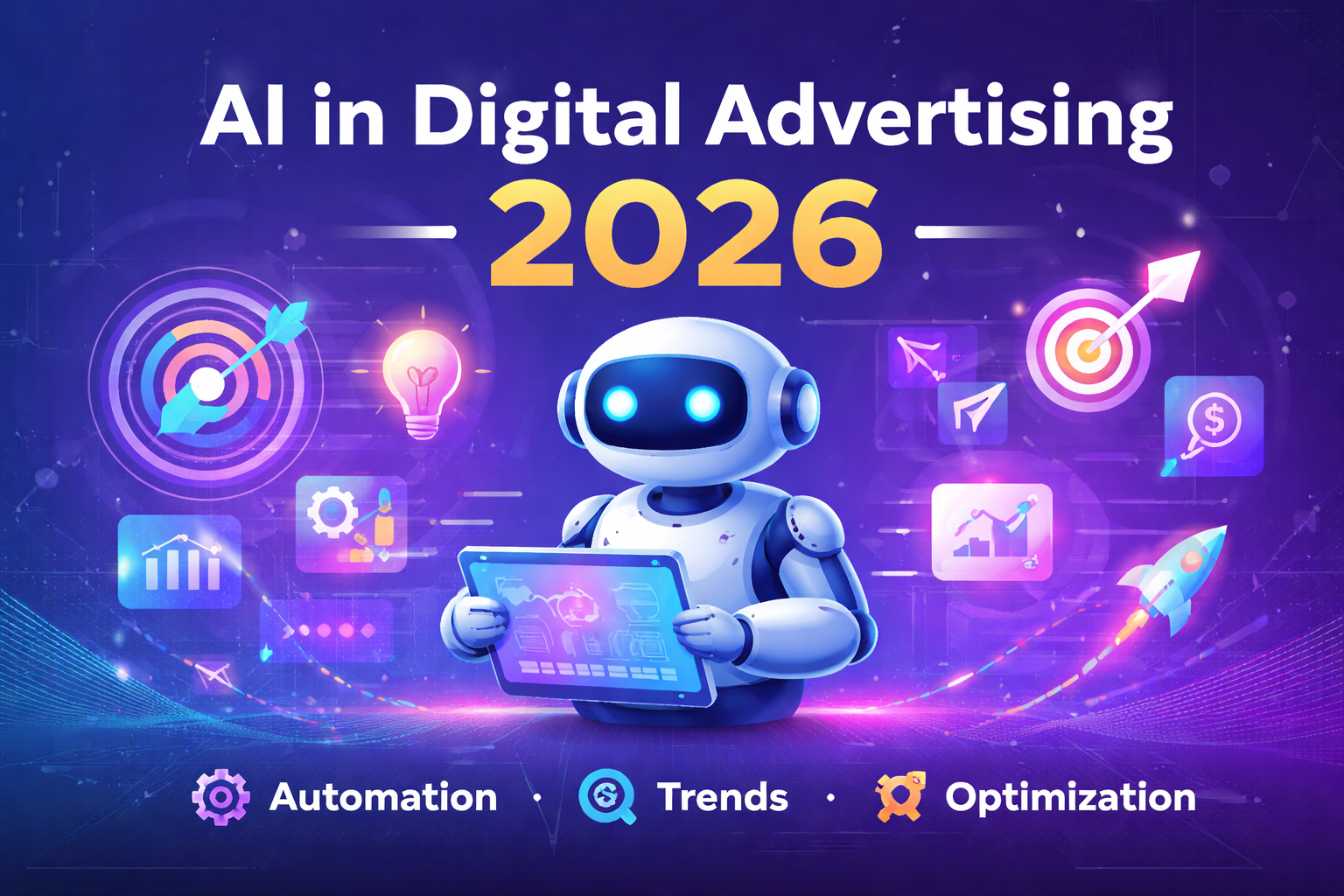
Artificial Intelligence (AI) and automation are redefining digital advertising in 2026.
What once required manual effort—campaign setup, bid management, and performance tracking—is now increasingly handled by intelligent systems. Platforms like Google Ads, Amazon Ads, and Microsoft Advertising have embedded AI deeply into their ecosystems, making automation the default approach.
This evolution is transforming how advertisers operate—and how advertising software must adapt.
In this article, we explore:
- Key AI advertising trends in 2026
- How automation is changing campaign management
- How our platform is evolving to stay ahead
What Is AI in Digital Advertising?
AI in digital advertising refers to the use of machine learning, predictive analytics, and automation to:
- Optimize ad performance
- Automate campaign management
- Personalize user experiences
- Predict future outcomes
In 2026, AI is no longer an enhancement—it is the foundation of modern advertising systems.
Key AI Advertising Trends in 2026
1. Automated Campaign Management
AI-powered systems can now:
- Adjust bids in real time
- Allocate budgets dynamically
- Pause or scale campaigns automatically
This reduces manual intervention and improves efficiency across large-scale campaigns.
2. Predictive Advertising and Smart Bidding
Modern advertising platforms use predictive models to estimate:
- Conversion probability
- Expected return on ad spend (ROAS)
- Future campaign performance
This enables advertisers to make proactive decisions rather than relying on historical data.
3. Hyper-Personalization in Advertising
AI enables advertisers to deliver highly relevant ads based on:
- User behavior
- Search intent
- Context (time, device, location)
This shift from audience segments to individual targeting improves engagement and conversion rates.
4. Cross-Platform Advertising Optimization
Digital advertising is no longer limited to a single platform.
For example:
- Google Ads drives awareness
- Amazon Ads drives purchase intent
AI helps unify insights across platforms, enabling better budget allocation and performance optimization.
5. Privacy-First Advertising and First-Party Data
With stricter data privacy regulations and reduced reliance on third-party cookies, advertisers are shifting toward:
- First-party data strategies
- Contextual targeting
- AI-driven audience modeling
This ensures compliance while maintaining campaign effectiveness.
How AI Is Changing Campaign Management
Traditional campaign management focused on:
- Manual setup
- Bid adjustments
- Performance monitoring
In 2026, this approach is becoming obsolete.
The New Model: AI-Driven Campaign Management
Modern systems focus on:
- Automated decision-making
- Continuous optimization
- Real-time execution
Instead of managing campaigns manually, advertisers now guide AI systems with strategic inputs.
Our Approach: Building the Next Generation of Advertising Software
As a software company focused on digital advertising solutions, we are evolving our platform to align with these changes.
1. AI-Powered Recommendation Engine
Our system analyzes performance data to:
- Identify underperforming keywords
- Suggest campaign improvements
- Recommend budget reallocations
This transforms raw data into actionable insights.
2. Profit-Based Advertising Optimization
We go beyond traditional metrics like CTR and CPC.
Our platform focuses on:
- Profit per product (SKU-level analysis)
- True return on ad spend
- Business-level performance
This ensures that optimization aligns with real revenue impact.
3. Cross-Platform Campaign Intelligence
We integrate and analyze data across:
- Google Ads
- Amazon Ads
- Microsoft Advertising
This enables:
- Smarter budget allocation
- Unified reporting
- Better attribution insights
4. Automated Campaign Structuring
Campaign structure plays a critical role in performance.
Our automation capabilities include:
- Converting auto campaigns to manual campaigns
- Grouping keywords based on performance
- Continuous restructuring for optimization
This reduces manual effort while improving efficiency.
5. Predictive Performance Models
We are investing in predictive analytics to forecast:
- Campaign performance trends
- Conversion likelihood
- Scaling opportunities
This enables proactive campaign optimization.
6. Flexible Automation Modes
Our platform supports multiple levels of automation:
- Assist Mode (recommendations only)
- Semi-Automatic Mode (user-approved actions)
- Fully Automated Mode (complete campaign execution)
This provides flexibility for different types of advertisers.
7. Real-Time Monitoring and Anomaly Detection
We provide intelligent alerts for:
- Performance drops
- CPC spikes
- Budget inefficiencies
Each alert includes actionable recommendations to resolve issues quickly.
Benefits of AI and Automation in Digital Advertising
Implementing AI-driven advertising solutions offers several advantages:
- Improved campaign performance
- Reduced manual workload
- Faster decision-making
- Better budget utilization
- Enhanced personalization
These benefits are driving widespread adoption across the industry.
The Future of AI in Advertising
Looking ahead, AI will continue to evolve toward:
- Fully autonomous campaign management
- Deeper personalization
- Advanced predictive analytics
- Greater integration across platforms
Advertisers who adopt these technologies early will gain a significant competitive advantage.
Conclusion
AI and automation are transforming digital advertising in 2026.
The industry is moving from manual execution to intelligent systems that can analyze, predict, and act in real time.
As this shift continues, advertising software must evolve from simple management tools to advanced decision engines.
At our company, we are committed to building solutions that align with this future—helping advertisers achieve better results through smarter automation.
If you are looking to scale your advertising with AI-driven insights and automation, now is the time to adapt.