





Customer Relationship Management (CRM) automation is becoming one of the most important technologies for modern businesses.
Companies no longer want to manually move data between applications, send repetitive emails, or spend hours updating customer records.
Today, businesses expect their CRM systems to automatically connect with sales, marketing, finance, customer support, and analytics platforms.
CRM automation helps organizations improve productivity, reduce manual work, increase lead conversion rates, and deliver better customer experiences.
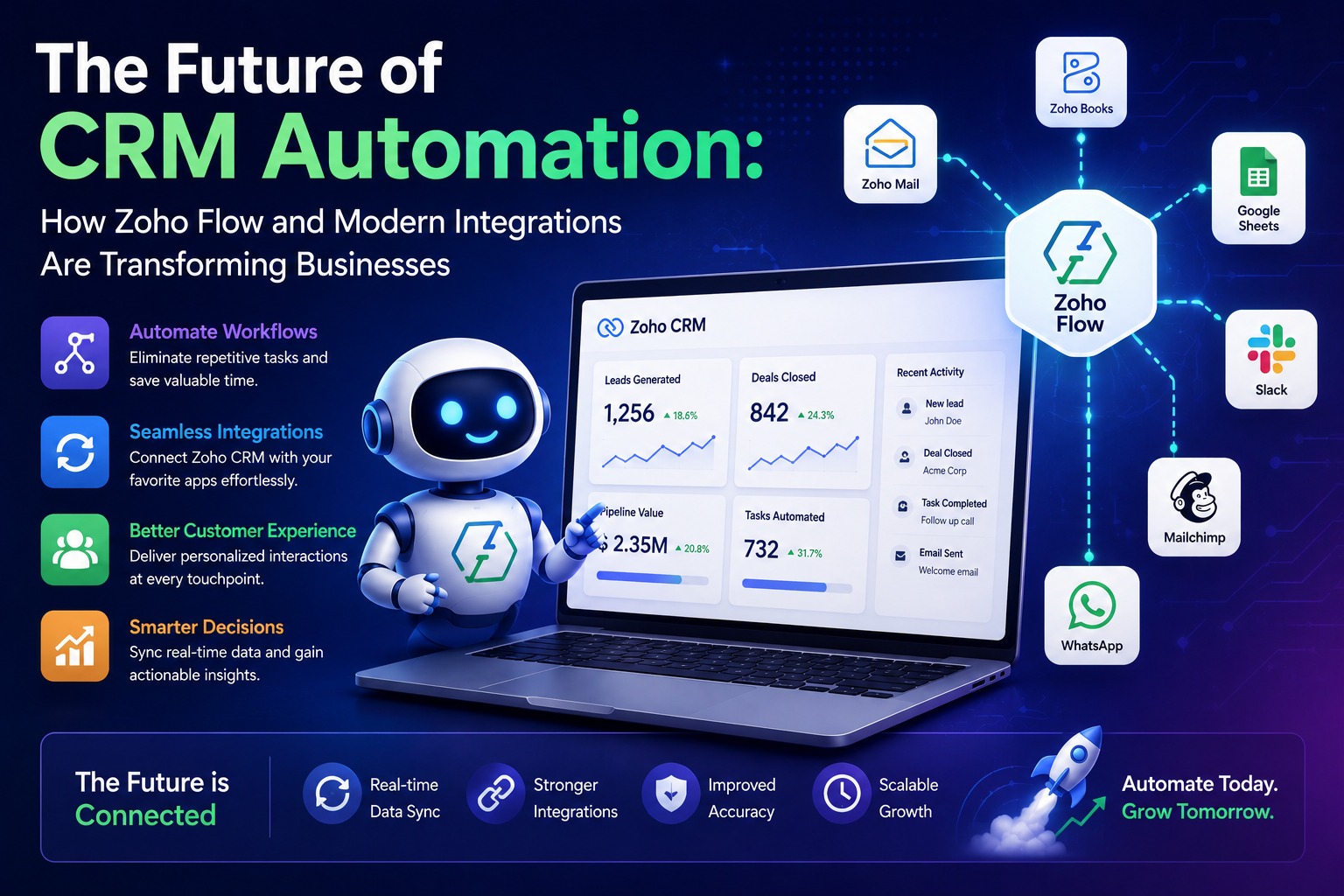
Among the leading automation platforms, Zoho Flow has become a popular choice because of its simple workflow builder, integration capabilities, and scalability.
In this blog, we will explore CRM automation, understand the role of Zoho Flow, and examine some of the most famous CRM automation platforms used by businesses worldwide.
What is CRM Automation?
CRM automation refers to the process of using software and workflows to automate repetitive customer-related activities.
Instead of manually entering customer details, assigning leads, updating statuses, or sending follow-up emails, automation tools perform these tasks automatically.
Common CRM automation activities include:
• Lead capture and assignment
• Email automation
• Customer onboarding workflows
• Sales pipeline updates
• Task reminders
• Support ticket creation
• Invoice and payment notifications
• Marketing campaign triggers
• Reporting and analytics synchronization
CRM automation enables teams to focus more on customer relationships and business growth rather than repetitive operational work.
Why CRM Automation is Important in 2026
Businesses generate customer data from multiple channels including websites, WhatsApp, email, social media, e-commerce stores, and mobile apps.
Managing this data manually creates delays, errors, and inefficiencies.
Modern CRM automation provides:
• Faster response time to customer inquiries
• Better lead nurturing
• Improved customer retention
• Reduced operational costs
• Real-time data synchronization
• Improved collaboration between teams
• Better business intelligence and reporting
Automation also plays a major role in AI-powered customer engagement where systems can automatically recommend actions based on customer behavior.
Zoho Flow: A Powerful CRM Automation Platform
Zoho Flow is a cloud-based integration and workflow automation platform developed by Zoho Corporation.
It allows businesses to connect applications and automate workflows without requiring complex coding knowledge.
Zoho Flow acts as a bridge between applications. When an event occurs in one application, Zoho Flow can automatically trigger actions in another application.
For example:
• When a lead is created in Zoho CRM, automatically send a welcome email.
• When a payment is completed, update CRM customer status.
• When a support ticket is raised, notify the sales team in Slack.
• When a form is submitted on a website, create a CRM contact instantly.
The platform uses a visual drag-and-drop builder that makes automation accessible even for non-technical users.
Key Features of Zoho Flow
1. Drag-and-Drop Workflow Builder
Zoho Flow provides a visual interface to create workflows quickly without advanced programming.
2. Multi-App Integration
It supports integrations with hundreds of applications including:
• Zoho CRM
• Gmail
• Slack
• Shopify
• QuickBooks
• HubSpot
• Google Sheets
• Mailchimp
• Trello
• Microsoft Teams
3. Conditional Logic
Businesses can create intelligent workflows using IF/ELSE conditions and filters.
4. Real-Time Automation
Actions can occur instantly when trigger events happen.
5. Custom Functions
Developers can add custom scripting and APIs for advanced integrations.
6. Error Handling and Monitoring
Zoho Flow includes execution logs and monitoring tools to track workflow performance.
7. AI and Smart Automation
Businesses can integrate AI services to improve lead scoring, email classification, and customer insights.
Popular CRM Automation Platforms in the Market
1. Zoho CRM + Zoho Flow
A strong combination for small and medium businesses looking for cost-effective automation.
2. Salesforce
One of the world’s largest CRM platforms with advanced enterprise-level automation and AI capabilities through Salesforce Flow and Einstein AI.
3. HubSpot CRM
Popular among marketing and sales teams for its user-friendly automation workflows.
4. Microsoft Dynamics 365
Widely used in enterprise organizations for integrating CRM with ERP and business intelligence.
5. Pipedrive
Focused on sales pipeline automation and lead tracking.
6. Freshsales
A CRM platform by Freshworks offering automation and AI-powered customer engagement.
7. Monday CRM
Provides customizable workflows for sales and project collaboration.
8. ActiveCampaign
Known for combining CRM with advanced email marketing automation.
Real-World CRM Automation Examples
Example 1: Lead Assignment Automation
When a customer submits a website inquiry form:
• Zoho Flow captures the form data
• Creates a new lead in Zoho CRM
• Assigns the lead to a sales executive
• Sends a notification email
• Creates a follow-up task automatically
Example 2: E-Commerce CRM Integration
When an order is placed:
• Customer information syncs with CRM
• Invoice generation starts automatically
• Customer receives order confirmation
• Marketing automation triggers future campaigns
Example 3: Support Ticket Automation
When a support issue is raised:
• CRM customer history is fetched
• Priority level is automatically assigned
• Technical team receives alerts instantly
• SLA tracking begins automatically
How AI is Changing CRM Automation
Artificial Intelligence is rapidly transforming CRM systems. Modern automation platforms can now:
• Predict customer behavior
• Score leads automatically
• Recommend follow-up actions
• Generate personalized emails
• Analyze customer sentiment
• Forecast sales trends
AI-powered CRM automation reduces manual decision-making and improves business accuracy.
Benefits of CRM Automation for Businesses
• Increased productivity
• Better customer experience
• Improved lead conversion
• Reduced manual errors
• Faster communication
• Enhanced team collaboration
• Better reporting and analytics
• Scalable business operations
CRM automation also allows businesses to grow without proportionally increasing operational workload.
Challenges in CRM Automation
Despite the advantages, businesses may face some challenges:
• Poor workflow planning
• Integration complexity
• Data inconsistency
• Employee resistance to automation
• Security and compliance concerns
Proper implementation strategy and testing are essential for successful CRM automation projects.
Best Practices for CRM Automation
• Start with simple workflows
• Identify repetitive business processes
• Keep customer data clean
• Monitor automation performance regularly
• Use AI-driven insights where possible
• Train teams properly
• Ensure proper security controls
• Continuously optimize workflows
Businesses should focus on automation that improves customer experience rather than simply reducing manual work.
The Future of CRM Automation
The future of CRM automation is moving toward intelligent, AI-driven ecosystems where applications communicate seamlessly in real time.
Businesses will increasingly adopt low-code and no-code platforms like Zoho Flow to accelerate digital transformation.
Future CRM automation trends include:
• AI agents for customer communication
• Hyper-personalized marketing automation
• Predictive analytics
• Voice-enabled CRM systems
• Cross-platform workflow orchestration
• Real-time customer intelligence
Organizations that adopt advanced CRM automation early will gain a major competitive advantage in customer engagement and operational efficiency.
Conclusion
CRM automation is no longer optional for modern businesses.
Platforms like Zoho Flow are making automation accessible, scalable, and powerful for organizations of all sizes.
By integrating CRM systems with sales, marketing, finance, and support platforms, businesses can create seamless customer experiences and improve operational efficiency.
As AI and automation technologies continue to evolve, CRM systems will become even more intelligent and proactive.
Companies investing in CRM automation today are preparing themselves for a smarter and more connected future.