






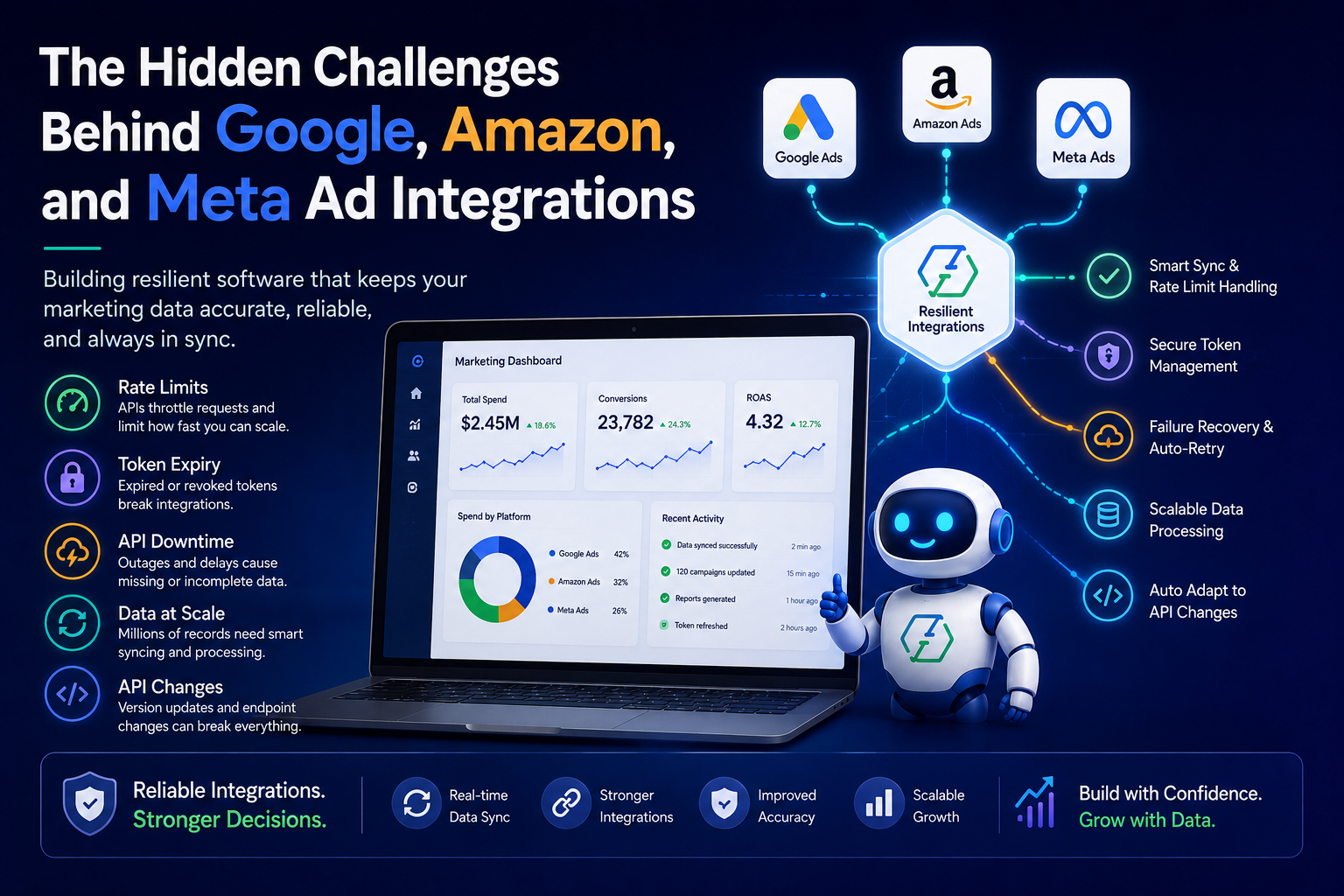
Marketing agencies rely heavily on advertising platforms such as Google Ads, Amazon Ads, and Meta Ads to manage campaigns, track performance, and deliver meaningful insights to their clients. While these platforms provide powerful APIs that make data access and automation possible, building reliable software integrations is far more complex than it may appear.
Many businesses assume that connecting to an advertising API is a one-time development task. In reality, advertising platforms continuously evolve, enforce usage limits, update authentication requirements, and occasionally experience service disruptions. Without proper planning and engineering practices, these challenges can result in missing data, inaccurate reports, broken dashboards, and frustrated users.
Over the years, we have learned that successful advertising integrations are not defined by how quickly they are built, but by how reliably they continue to operate when external systems change or fail. This article explores some of the most common challenges encountered when integrating with Google, Amazon, and Meta advertising platforms, and the approaches we use to build resilient solutions.
Challenge #1: API Rate Limits and Throttling
Every advertising platform places restrictions on the number of API requests that applications can make within a specific period. These limits are designed to protect platform resources and ensure fair usage among all developers.
For agencies managing multiple advertising accounts, rate limits can become a significant challenge. Large data synchronization jobs, frequent dashboard refreshes, or reporting requests across hundreds of campaigns can quickly consume available API quotas.
Potential Impact
- Delayed campaign reporting
- Missing performance data
- Slow dashboard updates
- Interrupted automation workflows
Our Approach
To handle rate limits effectively, we design systems that:
- Schedule API requests intelligently
- Process data through managed queues
- Automatically retry requests when temporary limits are reached
- Prioritize critical data synchronization tasks
- Monitor API consumption to avoid unexpected interruptions
By treating rate limits as a normal operating condition rather than an exception, we ensure that data continues to flow even during periods of high activity.
Challenge #2: Authentication and Token Management
Modern advertising platforms use secure authentication mechanisms that rely on access tokens and authorization workflows. While these security measures are essential, they introduce additional complexity into application development.
Access tokens expire regularly, permissions can be revoked, and authentication requirements may change over time. Without proper handling, these situations can cause integrations to stop functioning without warning.
Potential Impact
- Failed synchronization jobs
- Missing campaign data
- Increased support requests
- Unexpected downtime
Our Approach
We implement automated authentication management that includes:
- Secure credential storage
- Automatic token refresh processes
- Monitoring for authentication failures
- Early detection of expired or revoked permissions
- Recovery mechanisms that minimize service interruptions
This proactive approach reduces manual intervention and helps maintain consistent access to advertising data.
Challenge #3: Large-Scale Data Synchronization
Advertising platforms generate vast amounts of data every day. Campaign metrics, keyword performance, search terms, conversion data, audience insights, and attribution reports can quickly accumulate into millions of records.
As agencies grow and onboard additional clients, the volume of data increases significantly. Systems that work well for a handful of accounts may struggle when processing hundreds of accounts simultaneously.
Potential Impact
- Slow reporting systems
- Data processing bottlenecks
- Increased infrastructure costs
- Inconsistent reporting results
Our Approach
To manage large-scale synchronization efficiently, we focus on:
- Incremental data updates rather than full re-syncs
- Parallel processing where appropriate
- Scalable cloud-based architectures
- Optimized database and reporting strategies
- Efficient handling of historical and real-time data
These practices allow systems to scale while maintaining performance and reliability.
Challenge #4: Platform Downtime and Service Interruptions
Even the world’s largest technology companies occasionally experience service disruptions. API endpoints may become temporarily unavailable, report generation processes can be delayed, and responses may be incomplete during periods of platform instability.
Applications that assume external services are always available often fail when these situations occur.
Potential Impact
- Missing reports
- Incomplete dashboard data
- Failed automation processes
- Reduced user confidence
Our Approach
Rather than assuming perfect availability, we build systems that anticipate temporary failures.
Key strategies include:
- Automated retry mechanisms
- Graceful error handling
- Monitoring and alerting systems
- Recovery workflows for failed processes
- Validation of incoming data before processing
This fault-tolerant design helps maintain stability even when external platforms encounter issues.
Challenge #5: Continuous API Changes
Advertising platforms regularly introduce new features, update existing endpoints, and retire older API versions. While these improvements often provide additional capabilities, they can also create maintenance challenges for businesses that depend on these integrations.
A previously functioning integration can break when a platform changes authentication requirements, response formats, or endpoint behavior.
Potential Impact
- Unexpected software issues
- Broken reporting features
- Increased maintenance effort
- Delayed feature releases
Our Approach
To stay ahead of platform changes, we:
- Continuously monitor platform announcements
- Design integrations with flexibility in mind
- Maintain automated testing procedures
- Validate API responses before processing
- Plan upgrades proactively rather than reactively
This approach reduces risk and helps ensure long-term stability.
What We Have Learned from Advertising Platform Integrations
Building reliable integrations with Google, Amazon, and Meta advertising platforms has taught us several important lessons.
First, reliability matters more than features. Users can tolerate a delayed feature, but they quickly lose confidence in inaccurate or incomplete data.
Second, external APIs should never be treated as perfectly reliable systems. Rate limits, outages, authentication issues, and platform updates are inevitable. Successful software must be designed to handle these situations gracefully.
Third, monitoring and observability are just as important as development. Visibility into failures, performance issues, and synchronization delays enables faster problem resolution and better user experiences.
Finally, scalability should be considered from the beginning. As data volumes grow, architectural decisions that seemed sufficient during early development can become significant limitations.
Conclusion
Integrating with Google, Amazon, and Meta advertising platforms involves much more than connecting to an API. Reliable solutions must account for rate limits, authentication management, large-scale data processing, platform outages, and ongoing API changes.
By designing systems that anticipate these challenges, businesses can build software that remains dependable even as the advertising ecosystem continues to evolve. The goal is not simply to access data, but to ensure that reporting, automation, and decision-making tools continue to operate reliably when it matters most.
In an industry where data drives strategy and client trust depends on accuracy, resilient integrations are not just a technical advantage—they are a business necessity.